
Many companies expect AI agents to reduce manual exception handling and speed up decisions when something goes wrong. What often happens first is something else: the preparation alone reveals where data, interfaces and responsibilities do not fit together. Closing these gaps improves your processes before the first agent goes live.
Few technology topics are discussed as intensely in logistics right now as AI agents: software that does not just answer questions, but plans tasks on its own and carries them out in systems. Gartner counts agentic AI and collaborative multi-agent systems among the top supply chain technology trends for 2026.[1] For supply chain software with agentic capabilities, the analyst firm expects spending to rise from under 2 billion US dollars in 2025 to 53 billion US dollars in 2030. The share of companies using such capabilities in their supply chain software is expected to grow from 5 to 60 percent.[2]
The same analysis contains a caveat, though: adoption in companies will lag behind technical availability. Gartner attributes this to the gap between the technology and the other layers of the operating model, namely data management, operational control, the AI maturity of the workforce, willingness to change and connectivity with partners.[2] Germany shows a similar picture:
This matches a typical situation in practice. In the warehouse and in transport, a warehouse management system (WMS), ERP, a transportation management system (TMS), yard management, carrier portals, Excel lists and email inboxes all run side by side. People bridge the gaps between them with experience, phone calls and manual rework. An AI agent cannot simply take over that role if it cannot read the data reliably and operate the systems in a controlled way.
In our view, the lasting value of AI agents comes less from the agent itself than from what its introduction forces you to do. An agent works only as reliably as the data, interfaces and rules it relies on. If you want to introduce one, you have to rework data, interfaces, permissions, standards and process knowledge, and that work pays off with or without an agent.
So the key question is no longer which agent you could use, but what has to be in place in your own processes and systems for an agent to work reliably.
For an international manufacturer of housing and feeding equipment for livestock farming, we rebuilt the comparison of quotes in transport tenders around an AI agent.
Starting situation:
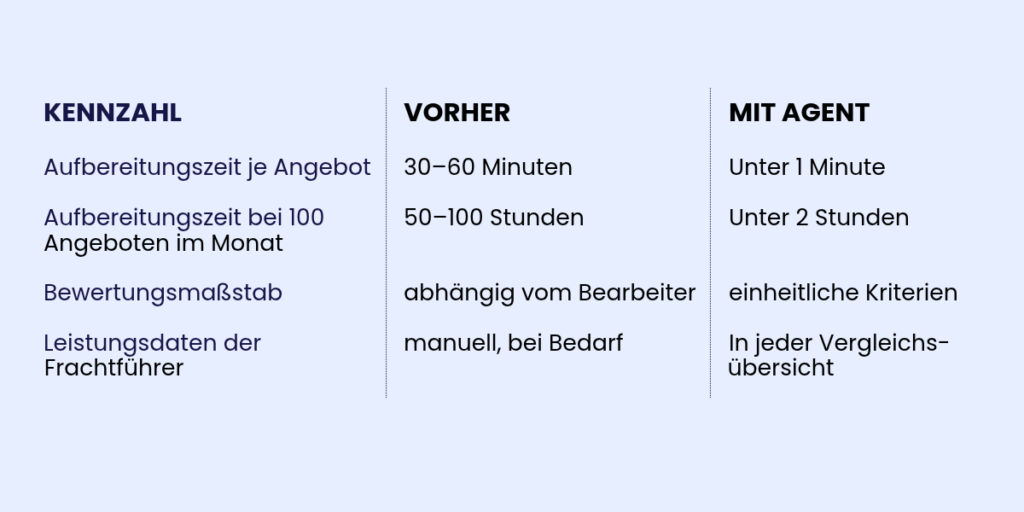
Several carriers respond to every tender, each in their own format: as a PDF attachment, as a spreadsheet or with prices in the body of the email. Dispatch had to match every quote to the right tender, extract prices and terms, check completeness and plausibility and transfer everything into a comparison sheet. Depending on scope, preparing a single quote took 30 to 60 minutes, which added up to several hours per tender.
A pattern many companies know: under this time pressure there is little room to look at how carriers have performed so far, and incomplete quotes are noticed too late.
With an agent and workflow system:
Technically, the solution is based on the workflow platform n8n and a language model. The model accesses company-specific information through a connected knowledge base (retrieval-augmented generation, RAG for short). Structured data such as tenders and performance history is queried directly from the database.
What it took:
The agent works because the groundwork was done first:
This groundwork alone makes the tendering process more transparent, with or without an agent.
What a sensible start looks like
A language model extracts information, classifies it and evaluates it. An AI agent uses this ability, breaks a task down into steps, accesses systems and tools to do so and carries out the actions the company has defined. The more an agent does on its own, the clearer the process, data and decision rules need to be. If you want to assess the use of AI agents, start with the process, not the tool:
AI agents in logistics make a noticeable difference wherever people today gather information from many sources in order to decide. The use case shows the scale: 30 to 60 minutes of preparation per quote become less than one minute. But this only became possible through clean data, clear criteria and well-defined roles.
Companies that build this foundation benefit twice: their processes become more stable today, and they are prepared for the next generation of technology, whatever it is called.
Which process takes up the most time in your logistics? We help companies identify suitable use cases, assess processes and data and bring AI agents into operation in a structured way. Get in touch with us.
Want to use AI in your logistics? This is how we support you: AI & Automation and AI Check.
You are chatting with an AI. It answers only from this website and can make mistakes. Please do not enter personal data. Privacy (in German)